
Essential EHR features prescribers need to reclaim hours and reduce burnout
Key Takeaways
- Prescribers lose hours each week to documentation, fragmented workflows, and inefficient EHR design.
- Nearly half of physicians now report burnout, fueled by administrative overload and systems that don’t work together.
- Essential EHR features include AI-powered documentation, integrated lab ordering and results, and safe, efficient e-prescribing.
- PracticeQ is the EHR designed for prescribers, built to save time, connect workflows, and keep the focus on patient care.
An EHR for prescribers should be a clinical ally. It should protect attention, reduce wasted steps, and keep patient care at the center.
But too often, it does the reverse. From logging in to ordering labs, it should smooth the encounter. Instead, it creates friction at every step, fueling administrative overload and pushing prescribers toward burnout.
So what do prescribers really need from an EHR? This piece looks at the essentials that reduce burden and the features that turn technology into a partner in care.
Understanding the prescriber’s struggle with EHRs
For many prescribers, their electronic health records (EHR) system has become less of a tool and more of a trade-off. Instead of creating space for patient care, it introduces new layers of strain that compound throughout the day and wear down clinical focus.
Administrative overload
Documentation rarely ends with the last patient of the day. Notes, orders, and inbox messages often spill into off-hours, a pattern so common it’s widely known as “pajama time.” In one study, more than a third of physicians reported spending three or more hours each night on EHR tasks outside the clinic.
That kind of load doesn’t just stretch out your workday. It erodes focus during encounters and drains the time and energy needed to sustain patient care over the long term.
Workflow inefficiency
When core tasks live in separate systems, even simple encounters become harder than they should be. Ordering a lab may require leaving the charting screen, while sending a prescription can mean another login. Over time, notes, results, and orders drift apart instead of staying connected.
And the cost isn’t just a slower process. Each extra step pulls your attention away from the patient and back onto the computer. Before long, you’re spending more of the day navigating the system than practicing medicine.
Burnout and frustration
Burnout is a reality for prescribers in every setting. Among physicians, nearly 50% report symptoms of burnout, and three in four of those point to the EHR as a contributing factor. In fact, recent studies show EHR usability scores as low as 25 out of 100, with clinicians in the lowest group more than three times as likely to burn out.
That gap between what prescribers need and what most systems deliver leaves clinicians drained, eroding both satisfaction with their work and presence with their patients. Burnout isn’t a side effect of EHR use; it’s the outcome of systems that make care harder instead of easier.
Essential EHR features that prescribers need
The measure of an EHR isn’t how much it can do, but how well it supports care. Prescribers need tools that cut clerical weight, close workflow gaps, and keep focus on the patient.
Clinical documentation that writes itself: AI scribe
Documentation is necessary, but it shouldn’t slow every encounter or extend the day. The simplest solution is to let the record build itself while you focus on the patient.
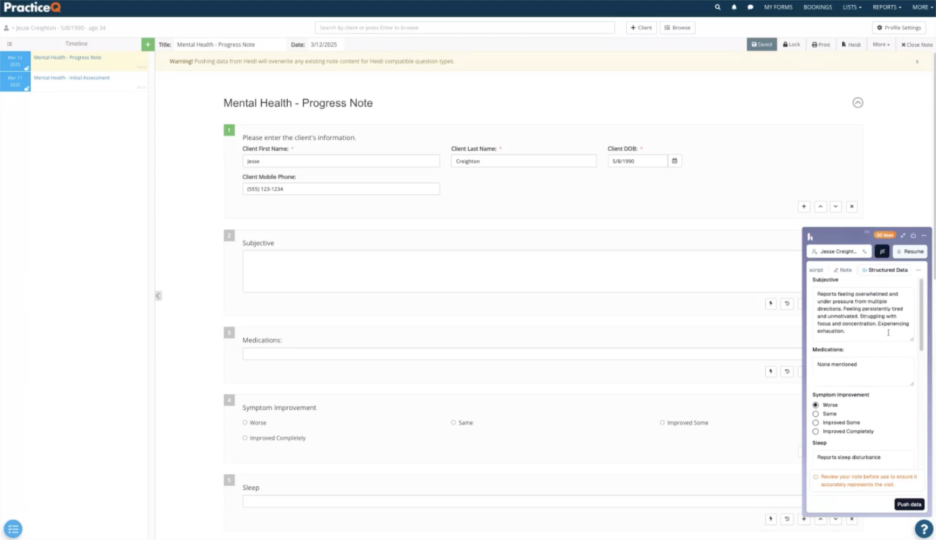
PracticeQ integrates with Heidi, an AI medical scribe that captures the visit as it happens, transcribes the conversation, and produces a draft note you can review and finalize before moving on.
With Heidi, you get:
- Real-time transcription built directly into the chart
- Notes in your format using templates you already rely on
- Adaptation over time so documentation reflects your style
By the time the visit ends, you already have a usable note, without the backlog that usually waits after clinic.
Seamless ordering and results: Integrated labs
Ordering labs shouldn’t pull you out of your workflow. Yet in many systems, it means logging into a separate portal, re-entering patient information, and then waiting for results to come back by fax or email. Each step interrupts the encounter and scatters critical data.
PracticeQ connects lab ordering and results directly to the chart. You can order from major labs and specialty services without leaving the EHR, and the results flow back automatically into the patient record. Trends are easy to review, and nothing gets lost in transit.
Integrated labs mean less double entry, fewer delays, and a clearer clinical picture at the moment you need it.

Fast, safe, and simple prescriptions: e-Prescribe
Prescribing is one of the most high-stakes tasks in practice. A single error can compromise safety, and even small inefficiencies ripple into delays for patients. When the process is spread across systems, the risks and frustrations only grow.
With PracticeQ’s e-prescribe, the essentials happen in one place:
- Medication history and formulary visible at the point of prescribing
- Interaction and dosage checks before the order is sent
- Refill requests managed directly in the chart
Keeping prescribing inside the chart reduces errors, shortens wait times for patients, and cuts out the back-and-forth that slows your day.

Beyond the basics: Additional features for an optimal EHR
Every practice has its own priorities. For some, the value is in an interface that minimizes frustration; for others, it’s the assurance of strong security or the flexibility to shape workflows around how care is delivered. The best EHR is the one that works for your practice.
Intuitive User Interface
An EHR should be easy to navigate. If every task takes clicks and backtracking, the system becomes another obstacle. A clear interface can shorten the learning curve, reduce mistakes, and make daily use less of a grind.
When the design works, you don’t think about the software at all. You can move through visits smoothly and keep your attention on the clinical work.
HIPAA-Compliant Security
An EHR isn’t complete without strong security. Every encounter generates sensitive data, and protecting it is non-negotiable.
Security must cover the essentials:
- Controlled access so staff only see what’s appropriate
- Encryption whether records are viewed in the clinic or remotely
- Audit trails that show exactly who opened a chart and when
With these safeguards built in, prescribers can use the system with confidence, knowing it supports patient care today and scales safely as the practice grows.
Choosing the right EHR for your practice
An EHR has to do more than cover the basics. It should grow with your practice, adapt to different workflows, and provide reliable support when you need it. Evaluating systems side by side is the best way to see where they meet (or miss) those needs.
Use the checklist below as you compare vendors. Print it, bring it into demos, and check off what each system can actually deliver. You’ll see quickly which platforms line up with your priorities and which leave gaps.
EHR Evaluation Checklist
Lining up systems against criteria like these turns the choice from guesswork into a clear comparison. The goal isn’t just finding an EHR that works today, but one that will continue to support your practice as it evolves.
☐ Documentation tools that let you finish notes during clinic hours
☐ Integrated labs that order and return results inside the chart
☐ HIPAA-compliant security built into daily workflows
☐ Customization options to fit the way your team practices
☐ Scalability to handle growth without disruption
☐ Responsive support and training resources
☐ An interface that minimizes clicks and frustration
☐ E-prescribing with safety checks and pharmacy communication
How PracticeQ Meets Your Needs
Prescribers carry enough weight without an EHR adding to it. The right system should ease documentation, keep labs connected, and make prescribing safe and straightforward.
PracticeQ delivers those essentials in one place:
- AI Scribe helps you close notes before the day is over
- Integrated labs keep orders and results inside the chart
- e-Prescribing adds safety checks and speeds communication with pharmacies
Together with a clear interface, strong security, and flexible workflows, these features make the system a true partner in care.
Stop letting your EHR add to the burden. Start your free trial of PracticeQ and see what it feels like when the system works the way you do.
EHR FAQs for Prescribers
How can an EHR reduce prescriber burnout?
An EHR reduces burnout by cutting after-hours charting and consolidating tasks like documentation, labs, and prescribing into one workflow.
What is the benefit of an EHR with integrated labs?
Integrated labs let you order tests and view results directly in the chart, reducing delays, errors, and duplicate work.
Is e-prescribing a standard feature in most EHRs?
Most EHRs include e-prescribing, but systems vary in how well they handle safety checks, controlled substances, and pharmacy communication.
How does AI Scribe improve clinical documentation?
AI Scribe records the encounter in real time and produces a draft note, helping prescribers finish documentation before the end of the day.
What should I look for in a HIPAA-compliant EHR?
A HIPAA-compliant EHR should include access controls, encryption, and audit trails to protect patient data without slowing down workflow.
FAQs
Barr, W., Peterson, L., & Fleischer, S. (2024). Pajama Time: The Association of EHR Documentation Time with Family Medicine Resident Outcomes. The Annals of Family Medicine, 22(Supplement 1), 6628–6628. https://doi.org/10.1370/afm.22.s1.6628
Budd, J. (2023). Burnout related to electronic health record use in primary care. Journal of Primary Care & Community Health, 14. https://doi.org/10.1177/21501319231166921
Lohmann-Lafrenz, S., Sigmund Østgård Gismervik, Ose, S. O., Lene Aasdahl, & Eivind Schjelderup Skarpsno. (2025). Usability of an electronic health record 6 months post go-live and its association with burnout, insomnia and turnover intention: a cross-sectional study in a hospital setting. BMJ Health and Care Informatics, 32(1), e101200. https://doi.org/10.1136/bmjhci-2024-101200
Norton, C. (2025, August 1). Improve Your Patient Treatment Adherence Rates with Integrated Prescriptions. PracticeQ. https://www.practiceq.com/resources/improve-patient-adherence-rates-integrated-prescriptions