
Key Takeaways
- Patient retention in healthcare often breaks down between visits, not during them.
- Missed follow-ups, unclear next steps, and passive reminders are the most common causes of drop-off.
- Communication that prompts action, not just awareness, helps patients stay engaged in care.
- Consistent workflows across reminders, follow-ups, and messaging reduce gaps and no-shows.
- Retention improves when communication is automated, visible to your team, and tied to the patient record.
Patients drop off for all kinds of reasons, from scheduling conflicts to losing motivation between sessions. More often than not, patient retention in behavioral healthcare comes down to communication gaps rather than quality of care. All it takes is one missed reminder or unanswered cancellation to lose someone for good.
The practices that retain patients best have one thing in common: consistent, thoughtful outreach. Here are five ways to build that into your practice.
Why Patient Retention Breaks Down in Behavioral Health
Behavioral health practices lose patients earlier than most realize. Research suggests that roughly one in five patients drop out of treatment prematurely. What’s more, over 70% of that dropout happens after the first or second visit, right when patients are still deciding if the process is worth continuing.
It’s also worth noting that not all dropout is the same, and some patients leave having met their goals. But for those who disappear without improvement, it's usually a missed appointment with no follow-up, unclear next steps, or too much friction to rebook. Small gaps, big consequences.
How Communication Directly Impacts Retention and Revenue
Communication keeps patients connected to care. When patients know what happens next, receive timely reminders, and hear from your team after a cancellation or missed visit, they’re more likely to stay on the schedule and continue treatment. That consistency supports retention because it removes the friction that often leads to drop-off in behavioral health.
When that friction is gone, more patients come back for their next session without you having to track them down. Your schedule fills in the way it’s supposed to, with fewer last-minute gaps and less time spent chasing reschedules. In behavioral health, regular communication keeps care moving and maintains the steady visit volume your practice depends on.
1. Set Clear Expectations Before and After Every Visit
In behavioral health, consistency is the treatment. If a patient leaves without a scheduled follow-up, the next visit loses priority. And once that happens, it often never gets booked.
That’s why it’s important to confirm the next step before the patient leaves, then reinforce it after the visit. That way, you can keep the next step clear instead of leaving it open to interpretation.
Standardize Pre-Visit and Post-Visit Communication
- Before the visit. Patients should arrive knowing what to bring, what to expect, and how to join if it's telehealth. Automated reminders deliver everything they need without anyone on your team lifting a finger.
- After the visit. Lock in the next appointment before they leave and send a confirmation while the session is still top of mind.
- If plans change. Give patients a way to cancel or reschedule without a phone call, so a scheduling conflict doesn't turn into a quiet exit.
2. Make Appointment Reminders Consistent and Actionable
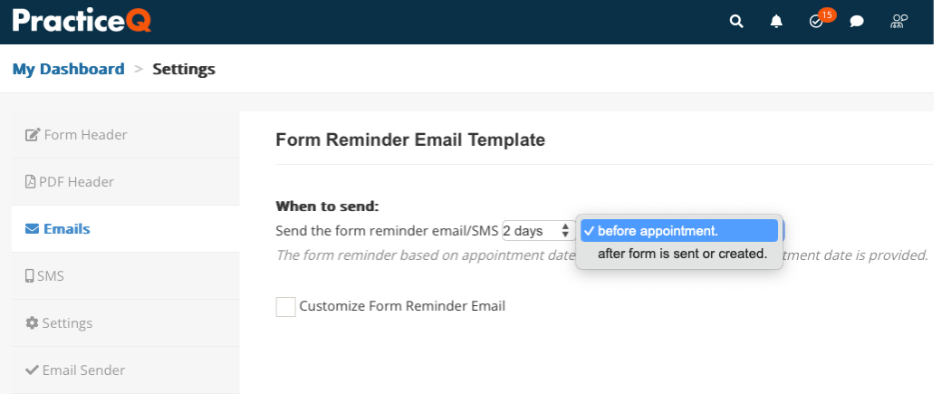
Most practices already send reminders. But the problem usually isn't frequency. It's that a message stating a time and date doesn't give patients anything to act on. They can't confirm or reschedule, and you won't know there's a problem until the slot is already empty.
Use Multi-Touch, Two-Way Reminder Workflows
- At booking. Send a confirmation that prompts the patient to respond, so you know early whether the appointment is locked in.
- Before the visit. Follow up with a reminder that lets them confirm, cancel, or reschedule directly, instead of ignoring the message.
- Closer to the appointment. Send a final touchpoint that surfaces last-minute changes while there’s still time to adjust the schedule.
3. Follow Up Quickly When Patients Miss or Cancel Visits
A missed appointment without a follow-up is often the last one. By the time you notice the pattern, they're already gone. And in behavioral health, where consistency is core to progress, even a single gap in care can be hard to recover from.
Create Automated Re-Engagement Workflows
- Same day or next day. Reach out while the visit is still fresh and make rebooking as easy as clicking a link.
- Skip the phone call. Patients who already missed once are unlikely to call in. Give them a way to reschedule on their own terms.
- Make it repeatable. Send a follow-up message when a visit is missed so it goes out every time, not just when someone remembers.
4. Keep Communication Consistent Across Channels
When communication lives in different places, your team loses track of it. You can’t see the full conversation, you don’t know what’s already been said, and patients end up repeating themselves or getting mixed responses. It slows everything down, creates extra work, and makes the experience feel disjointed.
Centralize Patient Communication in One System
- Keep messages tied to the patient record. Make sure every message, form, and update is saved to the chart so your team can see it without searching.
- Use one system across channels. Send texts, emails, and portal messages from the same place so conversations stay together.
- Keep the full conversation in one place. Reply from the patient record and avoid switching between inboxes so nothing gets split across tools.
5. Personalize Communication Without Adding Manual Work
Patients can tell when something was sent in bulk, and a message that feels generic is easy to ignore. At the same time, writing every message from scratch isn't realistic when your schedule is full and volume keeps climbing.
Use Automation That Still Feels Human
- Use templates as a baseline. Write messages once and reuse them so your tone stays consistent without starting from scratch every time.
- Adjust based on context. Tailor messages by appointment type, provider, or reason for outreach so they match what the patient actually experienced.
- Tie messages to actions. Connect outreach to bookings, cancellations, or missed visits so the right message goes out automatically with the right context already in place.
How to Build a Retention-Driven Communication System
Better retention starts with treating communication as a system, not a series of one-off tasks. When touchpoints run consistently, patients know what to expect, your team knows what's been handled, and nothing gets missed because someone was underwater.
Three things hold that system together:
- Automation. The right message reaches the right patient at the right time, every time.
- Visibility. Every interaction is tied to the patient record so nothing gets missed and no one has to ask what's already been said.
- Security. Communication stays HIPAA-compliant across every channel without adding steps to your workflow.
Most practices already know retention is a problem. The ones that fix it stop patching gaps manually and build something that runs whether the front desk is fully staffed or not.
See how PracticeQ helps you automate follow-ups, centralize communication, and keep patients engaged between visits. Schedule your demo and see how PracticeQ in action.
FAQs
What do you improve patient retention in behavioral health?
Why do patients stop attending appointments?
How does communication affect patient retention?
What are the best patient engagement strategies?
How can clinics reduce no-shows?
How to Increase Practice Revenue Without Raising Prices. (2025, November 5). PracticeQ. https://www.practiceq.com/resources/how-to-increase-practice-revenue-without-raising-prices
Kullgard, N., Holmqvist, R., & Andersson, G. (2022). Premature dropout from psychotherapy: Prevalence, perceived reasons and consequences as rated by clinicians. Clinical Psychology in Europe, 4(2). https://doi.org/10.32872/cpe.6695
Olfson, M., Mojtabai, R., Sampson, N. A., Hwang, I., Druss, B., Wang, P. S., Wells, K. B., Pincus, H. A., & Kessler, R. C. (2009). Dropout From Outpatient Mental Health Care in the United States. Psychiatric Services, 60(7), 898–907. https://doi.org/10.1176/ps.2009.60.7.898